
What Is a Facet Joint?
A Facet Joint is a small synovial joint at the back of the spine that connects neighboring vertebrae. Facet joints guide spinal motion, help limit excessive movement, and contain surfaces and tissues that can produce localized back or neck pain when irritated. Each joint works with discs, muscles, ligaments, and nerves.
Quick Facts About Facet Joint
Category
Spinal synovial joint
Used for
Guiding controlled spinal motion
Common confusion
Often confused with disc-related pain
Also called
Zygapophyseal Joint, Z-joint
Often discussed with
Back Pain Treatment
Key Takeaways About Facet Joint
- Facet joints sit between neighboring vertebrae.
- They guide bending and rotation in the spine.
- Facet joint pain is not the same as disc pain.
How Facet Joint Works
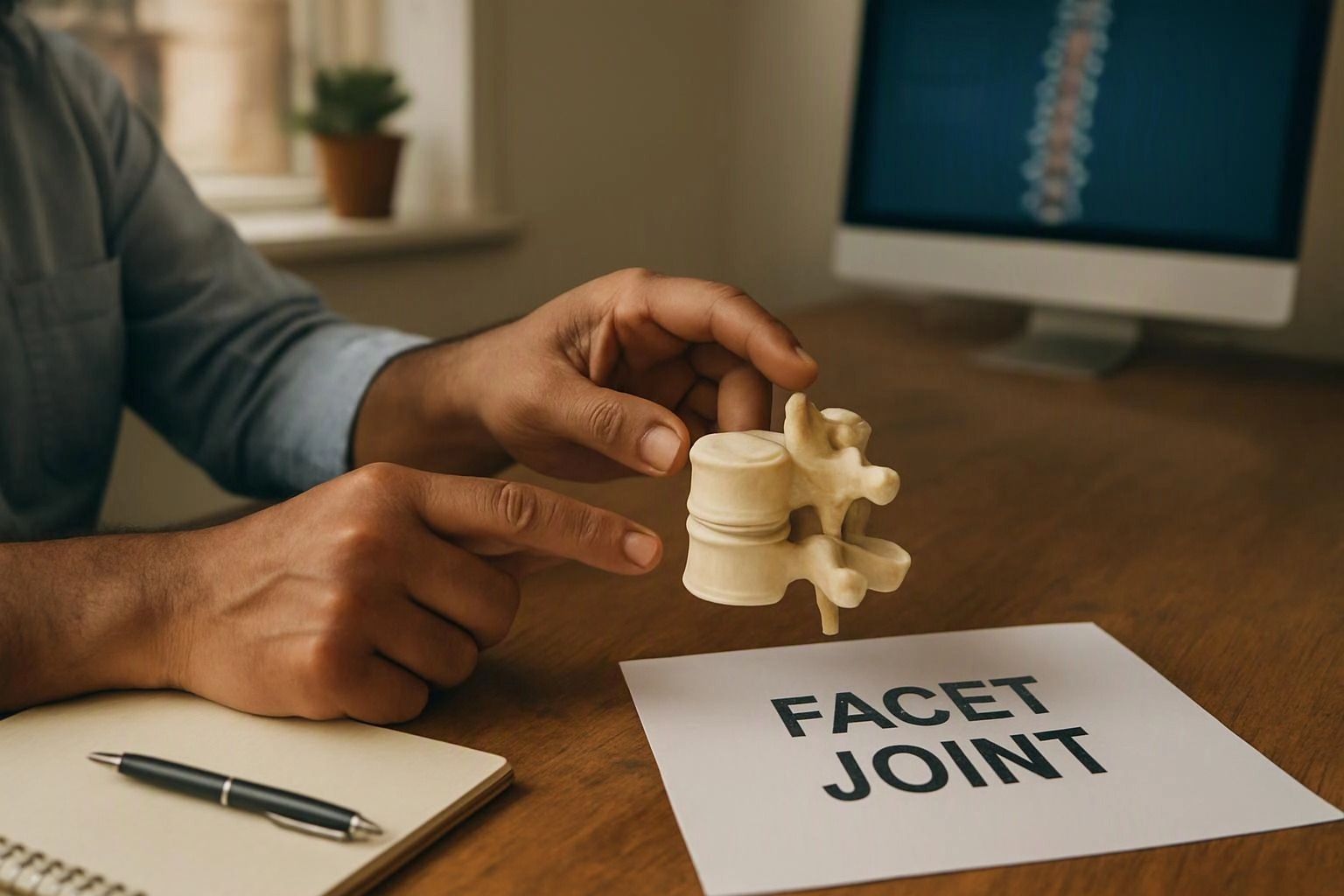
Facet Joint surfaces meet behind the vertebral bodies and help direct how nearby spinal segments move. A smooth layer of cartilage supports motion, while a surrounding capsule helps hold the joint together. Small nerves near the joint can communicate pain signals when local tissues become irritated.
Related glossary terms: Lumbar Spine, Vertebra, Joint Mobilization.
Clinicians consider facet joints alongside the lumbar spine, discs, muscles, and nerves during a back pain assessment. They may compare movement, tenderness, posture, and the pattern of symptoms. Facet-related discomfort often stays near the affected spinal area, although nearby muscles can also become tense. An examination cannot identify the pain source from one finding alone, so the full pattern guides clinical reasoning.

From the Arrowhead Clinic Chiropractor Riverdale team
When we assess back pain, we review spinal movement, posture, tenderness, and symptom patterns around the facet joints. Our team considers these findings with the surrounding muscles, discs, and nerves, so the care plan reflects the whole back region instead of one structure alone.
Facet Joint in Practice: A Real-World Example
A person with back pain may feel more discomfort during standing, extension, or rotation because those movements load the facet joints. The evaluation also checks nearby muscles and spinal motion to distinguish facet-related symptoms from other possible sources.
Related Services
Related Terms
Lumbar Spine
Lumbar Spine is the lower section of the spinal column between the thoracic spine and the…
Vertebra
A vertebra is a single bone in the spinal column that helps support the body, protect…
Joint Mobilization
Joint Mobilization is a manual technique that applies controlled movement to a joint to support motion…
Referred Pain
Referred Pain is a symptom pattern in which discomfort is felt in an area away from…
Arrowhead Clinic Chiropractor Riverdale
Have Questions About Facet Joint?
Contact Arrowhead Clinic Chiropractor Riverdale for practical guidance on Facet Joint and related chiropractor work in Riverdale.